The same moth as in the previous post but showing her frontal view.
And again her eggs (positioned in an array, sort of...) as photographed one day later; one can see that the colour is evolving from green towards brownish red. The eggs are not smooth but rather bumpy or perhaps even a bit "spiky"...? They remind me of seafood, for some reason...
Popular Posts
-
After a large Eucalyptus Mannifera tree has been removed from my garden several weeks ago I finally decided to plant something else in that ...
-
In my very first post on this blog I have shown so called Pink Bellied Moth (Oenochroma vinaria). It is fairly common in native gardens as t...
-
Here it is, one of my latest caterpillars; I have no idea what will grow out of it... It is feeding on eucalyptus leaves. Looks a bit trans...
-
About 1 month ago or so I have found a small pupa hanging on a silk thread in my garden under the rim of a plastic gardening pot. I assumed ...
-
One more photo of the same wasp as shown recently (seen here on the top of my pen). It is female, judging from white fragments in the middl...
-
Common name: Pink Bellied Moth (I will call her Penelope.) The interesting detail in this photo is the pheromone gland at the end of her b...
-
So, lets continue with the horror stories of butterflies ending their short lives in dramatic circumstancies... How about butterflies lured...
-
A proof to myself that my knowledge of insects is gradually growing; I took this photo 2 years ago and gave it a very simple title "an ...
-
His majesty Greenness has got a new robe, made out of white silk, I have found it this morning, how do you like it...? (Click on the image ...
Showing posts with label moth. Show all posts
Saturday, November 20, 2010
Wednesday, November 17, 2010
candidate for Miss November, Bronze Beauty...
This moth is quite large, with two large blue spots and a pattern of several (three) prominent parallel zigzag lines. I spotted her in our semi enclosed car port last evening, she was sitting still on the brick wall there. I took her inside the house for one evening/overnight and she laid some eggs, as seen on the photo (click to enlarge). The eggs are greenish and are roundish/ flat (cylindrical). Her scientific name is Dasypodia, common name is "Southern old lady" moth or simply "brown house moth", what a boring name (but at the same time quite a descriptive name...) The caterpillars feed on several (at least) acacia species. Will observe the eggs, and she can go outside, perhaps she will produce even more eggs...
Friday, November 12, 2010
Houdini 2
As I have explained before, Houdini has disappeared, maybe he is underground, who knows?
So, today I have started afresh with "Houdini 2". Will observe him much more closely this time and will report!
(Click on photo to see enlarged.)
So, today I have started afresh with "Houdini 2". Will observe him much more closely this time and will report!
(Click on photo to see enlarged.)
Wednesday, November 3, 2010
classic Australian icon
(No, not Don Bradman...)
Yes, I am talking about our iconic Bogong moth. They migrate south in spring to survive hot Australian summer in the crevices and caves of high mountains. I have seen several of them recently in Canberra, in my garden, on sidewalks, under my main entrance door, etc. They are looking for dark and cool crevices to help them preserve their moisture. I did not dare to try to eat one (they are edible), partially for fear of arsenic content, it was reported in the past that for some unknown reason some of them at least contain poison, and partially because I have no confidence in my insect cooking skills. Apparently the way to cook them is first chill them in the freezer (that should kill them with minimal or no pain; insects are cold blooded of course) and then use just flame of one match to cook one moth. Dewing and de-leg and "enjoy", hi, hi... Fat content nearly 40%...
There was a cafe in Manuka serving fritatas made out of Bogong moths (and other interesting bushtacker items). It existed a few years ago, this year I wanted to go and try their Bogong moths but could not find that cafe in the Yellow Pages anymore, looks like the menu was too exotic, not enough customers perhaps, what a pity...
new kids on the block
About one week ago I had a visitor, so called Magpie moth (Nyctemera) , it is called "magpie" because of black and white wings, here is her photo showing the characteristic top view. This type of moths are also called "tiger moths" because their abdomen often has black and yellow stripes; they mimic stripy wasps trying to scare (and warn) whoever would be tempted to eat them. Picture showing the strips on abdomen is the second one below.
The moth was a female and has left a few eggs on the twig it was sitting on, each egg smaller than 1mm....
And today several hairy caterpillars all emerged from the eggs. They are now about 2 mm long and very hairy. They feed on Senecio. (Photo of the caterpillar below was taken against the backdrop of a blue plastic box.)
The bristles are long. (In general one should avoid contact with hairy caterpillars as some species can cause severe itching, even can sting and/or cause blindness. Maybe this particular species is not dangerous, but you never know for sure...)
Interesting thing about tiger moths is that they can produce sounds (but in frequency range beyond human hearing abilities). Perhaps such sounds serve to confuse bats or discourage bats from eating tiger moths as they are not tasty anyway.
Tuesday, November 2, 2010
Second seductress
In my very first post on this blog I have shown so called Pink Bellied Moth (Oenochroma vinaria). It is fairly common in native gardens as the caterpillars feed on hakeas, grevilleas and other Proteaceas. Last winter I have found in total 4 pupae on the edges of the concrete path in my front garden, under the loose leaves. Here is how they looked like (one pupa shell is empty, after the moth has emerged and the other shell still full):
Yesterday last of the moths from the found pupae has emerged. They always emerge at night or early morning perhaps, I have never witness the process. What has emerged was a female moth again, I think.
Below are her photos taken yesterday, the blue flower in the background is an iris. And why do I think it is a female again and why do I call her "Second Seductress"? Well, because of her behavior, she is "calling" male moths by extending out her pheromone gland at the end of abdomen (click on the last photo to see it better). Chemical seduction. I let her escape last evening into the darkness of my garden, I hope it is not too cold at night, and I do hope she will find a mate and will produce eggs for next generations of pink bellied moths to come...
Monday, November 1, 2010
His Greenness lost his greenness...
Photo from today; I used to call him "his Greenness" when he was still a green caterpillar (one week ago or so), but now it does not seem an appropriate name anymore...
He is not moving anymore, stopped eating parsley, lost his green color completely; his look now reminds me of a lump of candle wax; the texture looks a bit grainy (click on the photo to enlarge)...I am not sure whether it is completely "normal", perhaps there are parasites inside?...Brr...Or am I worrying without any need?
Time will tell...
Yes, now I know, that grainy structures are actually cocoons of wasp parasites! The green caterpillar is no more!
Thursday, October 28, 2010
one day later
His Greenness looks somewhat pale today, perhaps changed his color a bit towards whitish-yellow, and he is not moving anymore...
He looks very peaceful, like an angel sleeping on a pillow made out of clouds...
I am not so sure anymore, is he a common pest? and so angelical at the same time?...
And if he turns out to be a common pest what will I do with him?
Is he going to be a night moth perhaps?
Still a few days to think about it...
Tuesday, October 26, 2010
The Emperor's new exquisite clothing, made out of fine 100% organic silk
His majesty Greenness has got a new robe, made out of white silk, I have found it this morning, how do you like it...? (Click on the image below to see very intricate details.)
He is still weaving it, so the robe is not finished yet, will post more pictures showing his progress...
Saturday, October 23, 2010
Inspecting the crime scene...
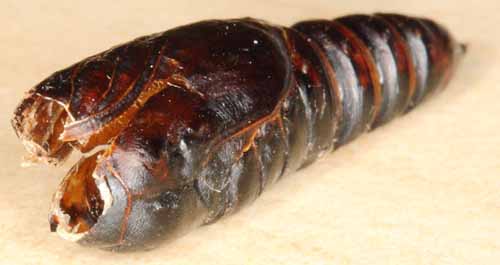
The remnant of the pupa:
Please note that instead of the long crack along the axis (which would be typical if the moth has emerged normally) there is a top part of pupa missing, presumably the culprit wasp emerges from the top part and not sideways like the moth would...
Labels:
caterpillar,
death,
ichneumon,
larva,
moth,
parasitoid,
pupa,
wasp
parasitoid wasp?
About 1 month ago or so I have found a small pupa hanging on a silk thread in my garden under the rim of a plastic gardening pot. I assumed it belongs to some lepidoptera...
But what has emerged from it today was not a butterfly nor a moth, to my great surprise....
It is a wasp (Ichneumon wasp), I assume it simply/gradually ate all the pupa except it's "shell" and then emerged as an adult ("hiperactive") wasp! (Call Crime Scene Investigators now...)
But what has emerged from it today was not a butterfly nor a moth, to my great surprise....
It is a wasp (Ichneumon wasp), I assume it simply/gradually ate all the pupa except it's "shell" and then emerged as an adult ("hiperactive") wasp! (Call Crime Scene Investigators now...)
Labels:
butterfly,
caterpillar,
death,
moth,
parasitoid,
pupa,
wasp
Thursday, October 21, 2010
side view
And one more shot; his/or her? Majesty Greenness...
A very hungry caterpillar indeed, eating healthy stuff all the time...
Wednesday, October 20, 2010
green larva eating parsley leaves
Monday, October 18, 2010
Pink seductress: Oenochroma vinaria
Common name: Pink Bellied Moth
(I will call her Penelope.)
The interesting detail in this photo is the pheromone gland at the end of her body. She is trying to attract males with a special chemical cocktail. Human beings can not smell it (or I couldn't at least...)
Pink seductress. Sitting pretty and waiting. And the males have to fly upwind, in the direction of her smell...
Subscribe to:
Posts (Atom)